
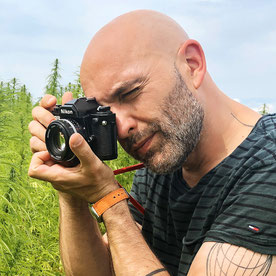
Tom Hofmann
Born 1973, lives and works in Vienna, Austria/Europe.
Thomas Hofmann‑Primavesi is a Vienna‑based artist working within the field of Expanded Photography and intermedial visual art. His practice revolves around human perception, sexuality, and the emotional and philosophical dimensions of being human. Experimental and conceptual imagery inspires him as much as the everyday, yet every work emerges from a process of self‑reflection rather than visual decoration. Creating purely “beautiful” photographs holds little appeal for him—each piece must carry meaning, intention, and a trace of thought behind it.
His artistic approach transcends media boundaries. He often begins with instant or analog photography and expands the image through digital refinement, material transformation, and layers of color and texture applied by hand—but ultimately, he never follows a rigid process, as even a simple mental image can form the starting point for a new work. Using techniques such as emulsion lifts and transfers, he explores how imperfection, material traces, and accidents can become part of an authentic visual language. This intermedial approach allows him to move freely between photography and painting, between digital and analog, between documentation and transformation.
Hofmann‑Primavesi’s work searches for intensity rather than spectacle, turning inner states and philosophical ideas into tangible visual forms. Themes such as eroticism, power exchange, longing, and vulnerability recur throughout his practice, paired with a quiet curiosity for the psychological complexity of human desire and perception. His project Schiele RemiXed, for example, illustrates this approach—an homage that reinterprets Egon Schiele's visual language while exploring intimacy, self-expression, and individual emotions in a contemporary context.
A lifelong fascination with photography began in his father’s studio, where he developed both technical precision and an early awareness of composition and light. During and after his apprenticeship as a photographer, he refined his craft while developing a lasting interest in experimental and conceptual image design. The rediscovery of instant film during the Impossible Project years marked the start of a new creative phase that reconnected him with the tactile, emotional nature of image‑making.
Hofmann‑Primavesi’s work has been exhibited internationally and featured in Raw Beauties – A Polaroid Project, Photodarium, and magazines such as PRYME and Séparée. Artist and writer Georg Barkas once described his imagery as “the shadow of the photographer—an interesting and beautiful shadow,” a sentiment that captures the introspective and emotionally charged essence of his visual language.
As a descendant by marriage of the Primavesi family—renowned patrons of Viennese Modernism and collaborators of the Wiener Werkstätten—Hofmann‑Primavesi extends this cultural legacy through his exploration of body, image, and perception, seeking a contemporary visual language grounded in reflection and emotional depth.
“Just as a painter decides between watercolor or oil to give an idea its proper form, I choose between analogue and digital—both in creating and transforming the image. Each medium offers its own truth, its own way of revealing what I want to express. Since my early youth, my deepest desire has been to work artistically. Through the camera and photography‑based processes, I found a medium capable of translating my thoughts, emotions, and desires into tangible visual form.”
Exhibitions:
2003: Group Exhibition > WUK, Vienna
2012: Participant > iso600 Festival della Fotografia Istantanea Milano, Italy
2013: Participant > 8×10 Selección - Impossible Project Space Barcelona, Spain
2013: Participant > MIA Milan Image Art Fair, Italy
2013: Group Exhibition > Prexer Łódź, Poland
2014: Group Exhibition > Wanrooij Gallery Amsterdam,
Netherlands
2014: Participant > Fotofever Art Fair, Paris
2015: Solo Exhibition > III. Viennese Rope Festival, Vienna
2019: Group Exhibition > Galerie Art Pool, Vienna
Publications:
2012: Participant > Photodarium
2013: Participant > Photodarium
2014: Participant > Raw Beauties | A Polaroid Project
2015: Participant > Photodarium
2015: Participant > PRYME Magazine, Issue #4, prymeeditions.com analogforevermagazine.com
2015: Feature > Séparée Magazine, Issue #6, separee.com
2016: Participant > Photodarium
2016: 12-page couple photo series > Séparée Magazine, Issue #9, separee.com
2017: Participant > Photodarium Private
2017: Monograph > self published, print-on-demand, concepts life erotic bondage
2018: Participant > Photodarium Private
2018: Project Zine > self published, print-on-demand, Egon Schiele RemiXed
2021: Participant > Photodarium Private

What participants tell about
attending my workshop
'signifying or signifying nothing'

Georg Barkas about Tom Hofmann (foreword to the self-published book concepts life erotic bondage)
Barkas holds a master’s degree in mathematical physics, and pursued a PhD in history and philosophy of science in Vienna and Berlin. His research was and is strongly influenced by the French poststructuralist movement. In 2014, Barkas quit academia to become a professional artist, educator, writer and researcher in the field of Japanese Rope Art.
When I was first asked by my dear friend Tom Hofmann to write a foreword to his collection of photographic works, I said to myself that it is an interesting task. I
like the idea of a textual foreword to a book without words. The most interesting part for me is the question of what a foreword in this special case could look like. I wished to avoid a mere
description of the pictures, and I do not want to tell the ‘reader’ what they will find in the book as this would rob them of the opportunity to form their own opinions. Furthermore, the
collection of Tom’s photographic art is so diverse that it is hard to find the continuity which is so often demanded in various fields of art. At the same time, it is exactly this lack of
continuity which makes it so interesting.
What, then, should I include in a foreword? I looked through the collection in Tom’s first draft and found my route in one of the pictures.
That one specific picture is a violent attack on the reader. It is one that screams that something is wrong, not only with the picture but with the world. In it, the borders between signifier and signified become almost indistinct. In the picture, a book is visible – Helmut Lethen’s “Der Schatten des Fotografen” or “The photographer’s shadow”. (Incidentally, Helmuth Lethen knows of his book’s appearance in Tom’s picture.) Lethen’s book shows the reader what is laying behind the pictures without setting up a fixed opinion about the picture itself. It tells us who the reader of pictures could be and who the author of a picture is.
The picture with the book and the book in the picture convinced me not to try to describe Tom Hofmann’s pictures, but to encourage the reader to rather look behind his incredibly diverse collection. In “concepts | life | erotic | bondage”, Tom Hofmann tells us who he might be.
Together, through their disconnectedness, the pictures show the shadow of the photographer – the shadow of Tom Hofmann. And it is, to me, an interesting and beautiful shadow. Georg Barkas, May 2017